St Robert Bellarmine Catholic Primary School
Curriculum Overview
“We are God’s work of art.”
At St Robert Bellarmine, we are passionate about ensuring every child fulfils their potential and becomes an all-round well-educated citizen with the knowledge needed to succeed in life. We follow the National Curriculum, which provides pupils with an introduction to the best of what has been thought and said by many generations of academics and scholars along with the essential knowledge that they need to be educated citizens.
Our curriculum is built around the aims and objectives set out in the National Curriculum, which covers the core subjects: English, Mathematics and Science, and the foundation subjects: Computing, History, Geography, Art and Design, Design Technology, Music, Physical Education, Languages (Spanish), Citizenship (including PSHE and RSHE) and Religious Education. The National Curriculum is just one element in the education of every child: it provides an outline of core knowledge around which teachers have developed a coherent and deliberately sequenced curriculum to promote the development of pupils’ knowledge and understanding.
The context of our school has been a major driver in the design of our curriculum and underpins all of the curriculum choices made to ensure it is fully inclusive of every child, and that it addresses each aspect of how a child develops, progresses and grows both academically and emotionally. Furthermore, our curriculum is designed to ensure we provide the essential Cultural Capital, which all of our pupils need, irrespective of their circumstances. This gives them the vital background knowledge required to be informed and thoughtful members of our community.
Our Intended Curriculum
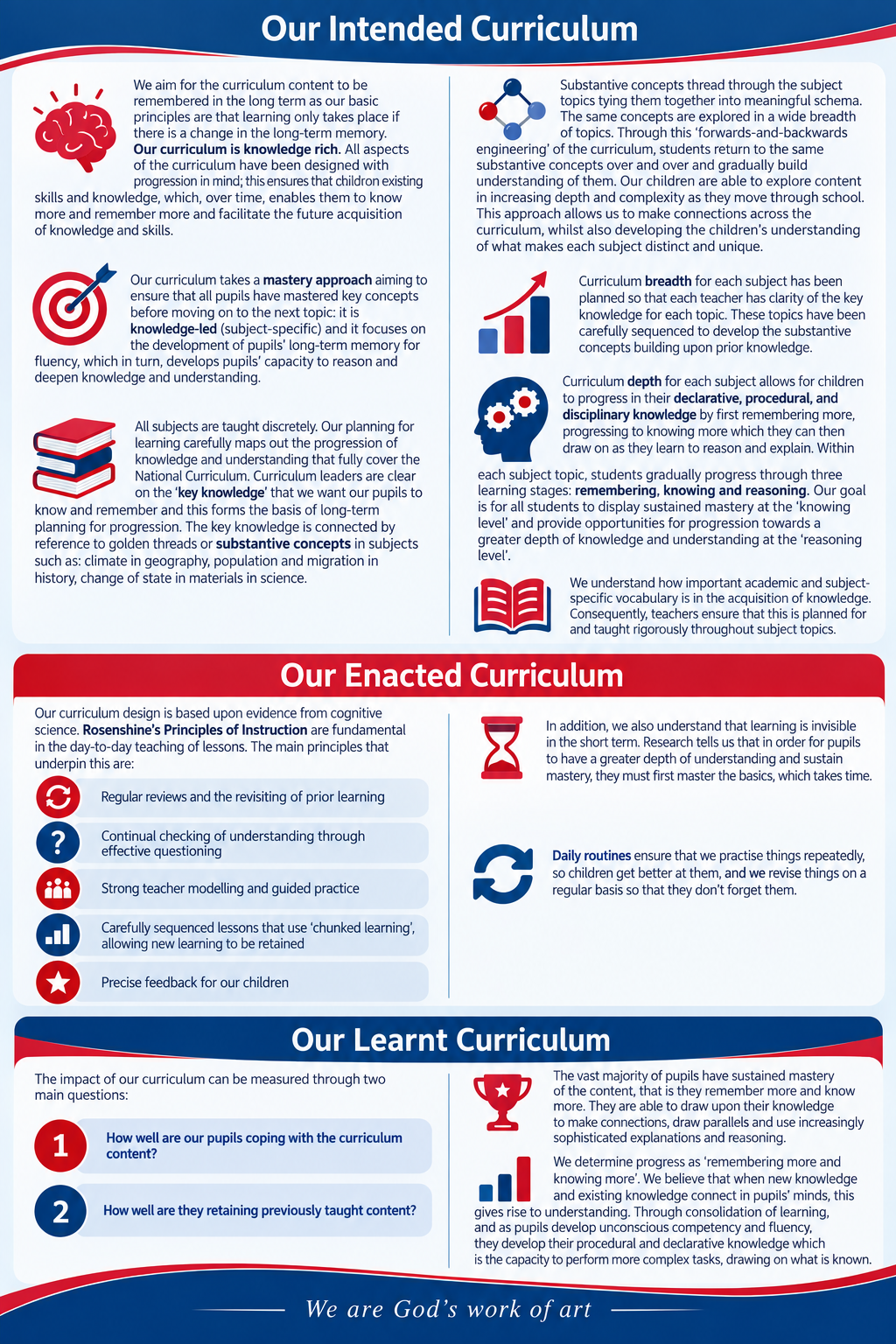
We aim for the curriculum content to be remembered in the long term as our basic principles are that learning only takes place if there is a change in the long-term memory. Our curriculum is knowledge rich. All aspects of the curriculum have been designed with progression in mind; this ensures that children build on existing skills and knowledge, which, over time, enables them to know more and remember more and facilitate the future acquisition of knowledge and skills.
Our curriculum takes a mastery approach aiming to ensure that all pupils have mastered key concepts before moving on to the next topic: it is knowledge-led (subject-specific) and it focuses on the development of pupils' long-term memory for fluency, which in turn, develops pupils' capacity to reason and deepen knowledge and understanding.
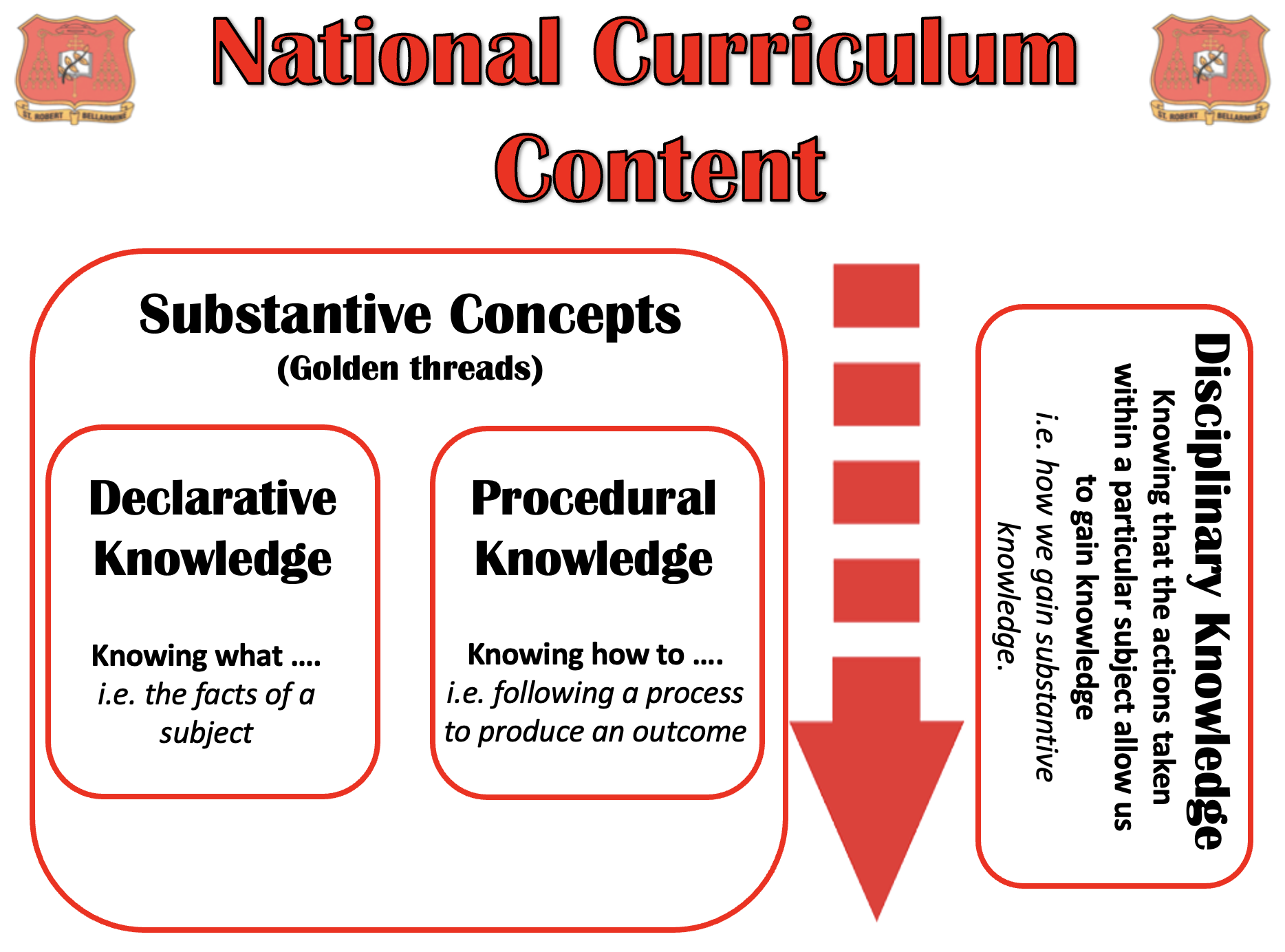
All subjects are taught discretely. Our planning for learning carefully maps out the progression of knowledge and understanding that fully cover the National Curriculum. Curriculum leaders are clear on the ‘key knowledge’ that we want our pupils to know and remember and this forms the basis of long-term planning for progression The key knowledge is connected by reference to golden threads or substantive concepts in subjects such as: climate in geography, population and migration in history, change of state in materials in science.
Substantive concepts thread through the subject topics tying them together into meaningful schema. The same concepts are explored in a wide breadth of topics. Through this ‘forwards-and-backwards engineering’ of the curriculum, students return to the same substantive concepts over and over and gradually build understanding of them. Our children are able to explore content in increasing depth and complexity as they move through school. This approach allows us to make connections across the curriculum, whilst also developing the children’s understanding of what makes each subject distinct and unique.
Curriculum breadth for each subject has been planned so that each teacher has clarity of the key knowledge for each topic. These topics have been carefully sequenced to develop the substantive concepts building upon prior knowledge.
Curriculum depth for each subject allows for children to progress in their declarative, procedural, and disciplinary knowledge by first remembering more, progressing to knowing more which they can then draw on as they learn to reason and explain. Within each subject topic, students gradually progress through three learning stages: remembering, knowing and reasoning. Our goal is for all students to display sustained mastery at the ‘knowing level’ and provide opportunities for progression towards a greater depth of knowledge and understanding at the ‘reasoning level’.
We understand how important academic and subject-specific vocabulary is in the acquisition of knowledge. Consequently, teachers ensure that this is planned for and taught rigorously throughout subject topics.
We determine progress as 'remembering more and knowing more'. We believe that when new knowledge and existing knowledge connect in pupils’ minds, this gives rise to understanding. Through consolidation of learning, and as pupils develop unconscious competency and fluency, they develop their procedural and declarative knowledge which is the capacity to perform more complex tasks, drawing on what is known.
We look for children, as their knowledge and understanding develops, to show that they can make connections, draw parallels and use increasingly sophisticated explanations and reasoning which draw upon their knowledge.
Our Enacted Curriculum
Our curriculum design is based upon evidence from cognitive science. Rosenshine’s Principles of Instruction are fundamental in the day-to-day teaching of lessons. The main principles that underpin this are:
-
regular reviews and the revisiting of prior learning
-
continual checking of understanding through effective questioning
-
strong teacher modelling and guided practice
-
carefully sequenced lessons that use ‘chunked learning’, allowing new learning to be retained
-
precise feedback for our children
In addition, we also understand that learning is invisible in the short term. Research tells us that in order for pupils to have a greater depth of understanding and sustain mastery, they must first master the basics, which takes time.
Daily routines ensure that we practise things repeatedly, so children get better at them, and we revise things on a regular basis so that they don’t forget them.
Our Learnt Curriculum
The impact of our curriculum can be measured through two main questions:
-
How well are our pupils coping with the curriculum content?
-
How well are they retaining previously taught content?
The vast majority of pupils have sustained mastery of the content, that is they remember more and are fluent in it. Activities are planned for pupils to combine this remembered knowledge and fluency with the opportunities to reason and demonstrate their depth of understanding. We regularly monitor pupils to ensure that they are on track to reach the expectations of our curriculum.
Our school is fully committed to the principles set out in our Accessibility Plan and to ensuring equality of opportunity for all pupils. In line with this commitment, we will continue to improve the extent to which disabled pupils can participate fully and independently in all aspects of the curriculum.
We will regularly review and adapt teaching strategies, learning resources, curriculum materials and the physical environment to identify and remove barriers to learning and participation. Where required, we will provide appropriate support, reasonable adjustments and specialist equipment to enable pupils to access learning effectively. Staff will receive ongoing training and guidance to develop their understanding and confidence in meeting a diverse range of needs.
Through effective monitoring, consultation with pupils and parents or carers, and regular review of our provision, we will identify areas for further improvement and ensure that appropriate actions are taken. Our aim is to create an inclusive and supportive learning environment in which every pupil can access, engage with and achieve across all areas of the curriculum, regardless of disability or individual need.